
Queen Elizabeth National Park is Uganda’s most visited and most biodiverse national park — a vast and extraordinarily varied protected area in southwestern Uganda that combines open savanna woodland crater lakes papyrus swamps and the shores of two Great Lakes into one of East Africa’s most complete and rewarding wildlife destinations.
Named after Queen Elizabeth II following her visit in 1954 and covering 1,978 km² of extraordinary landscape Queen Elizabeth National Park is home to tree-climbing lions the world-famous Kazinga Channel boat safari over 600 bird species elephants hippos buffalos leopards chimpanzees and some of Uganda’s most dramatic scenery.
This complete guide covers everything you need to know about visiting Queen Elizabeth National Park in 2026 — the wildlife the Kazinga Channel game drives chimp trekking costs best time to visit where to stay how to get there and how to combine it with gorilla trekking in Bwindi for the ultimate Uganda safari.
“For Uganda’s northern safari circuit read our Murchison Falls National Park complete guide.”
Queen Elizabeth National Park: Essential Facts
| Location | Southwestern Uganda — Kasese and Rukungiri Districts |
| Size | 1,978 km² |
| Altitude | 910m – 1,390m |
| Established | 1952 as national park |
| Lakes | Lake Edward (south) · Lake George (north) · Kazinga Channel (connecting) |
| Key attraction | Tree-climbing lions · Kazinga Channel boat safari · 600+ birds |
| Distance from Kampala | 410 km — approximately 5–6 hours by road |
| Distance from Bwindi | 90 km — approximately 2 hours by road |
| Nearest airport | Kasese airstrip (domestic) · Entebbe International |
| Management | Uganda Wildlife Authority |
Why Queen Elizabeth Park is Special
Queen Elizabeth National Park occupies a unique position in the Uganda safari landscape — it is simultaneously one of Africa’s most biodiverse national parks and one of its most accessible combining wildlife that rivals the finest East African savanna parks with experiences — the Kazinga Channel boat safari the Ishasha tree-climbing lions the Kyambura Gorge chimpanzees — that are completely unique to this one extraordinary place.
Extraordinary biodiversity Queen Elizabeth National Park is one of the most biodiverse national parks in Africa — 95 mammal species and 612 bird species within a single protected area. This diversity reflects the park’s extraordinary range of habitats — from open savanna and acacia woodland to papyrus swamp lakeside forest and the forested gorge of Kyambura.
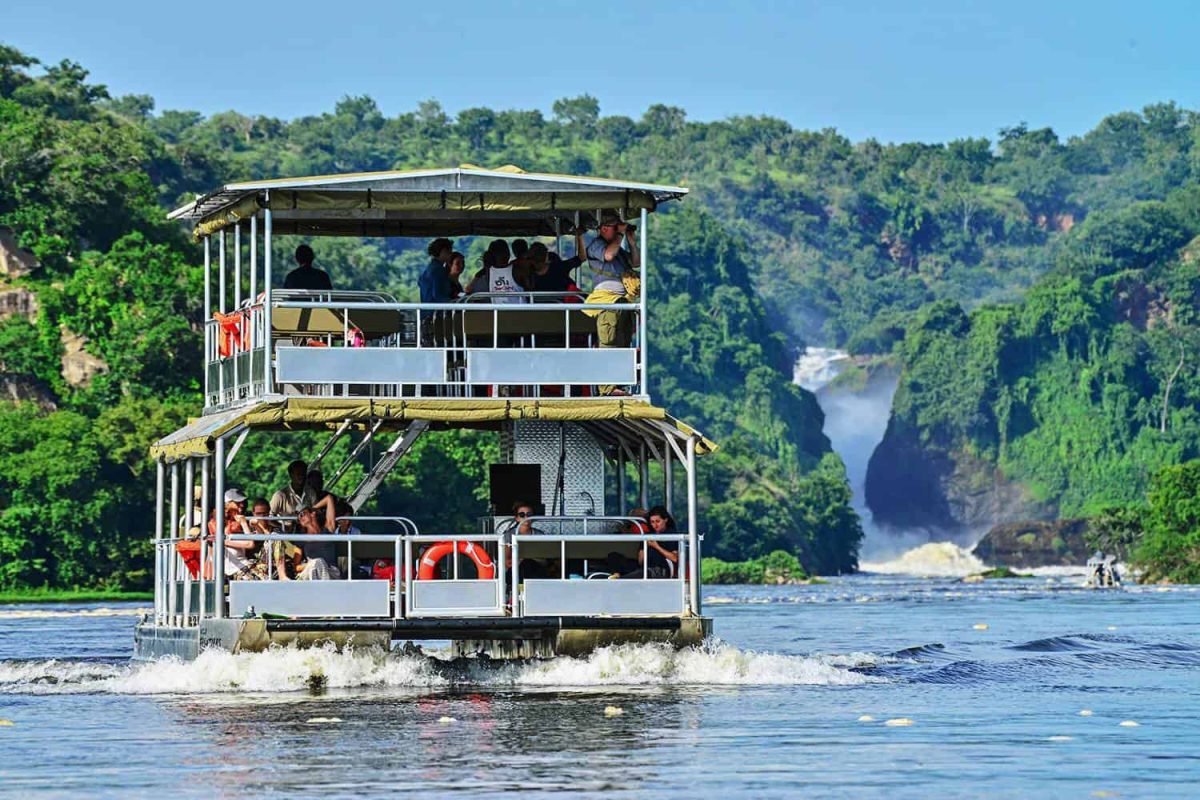
The Kazinga Channel — Africa’s finest boat safari The Kazinga Channel connects Lake George and Lake Edward through the heart of Queen Elizabeth National Park — a 32 km waterway that is home to one of Africa’s highest concentrations of hippos and Nile crocodiles and attracts thousands of waterbirds along its banks. The Kazinga Channel boat safari is the highlight of virtually every Queen Elizabeth National Park visit and one of the greatest wildlife boat experiences available anywhere in East Africa.
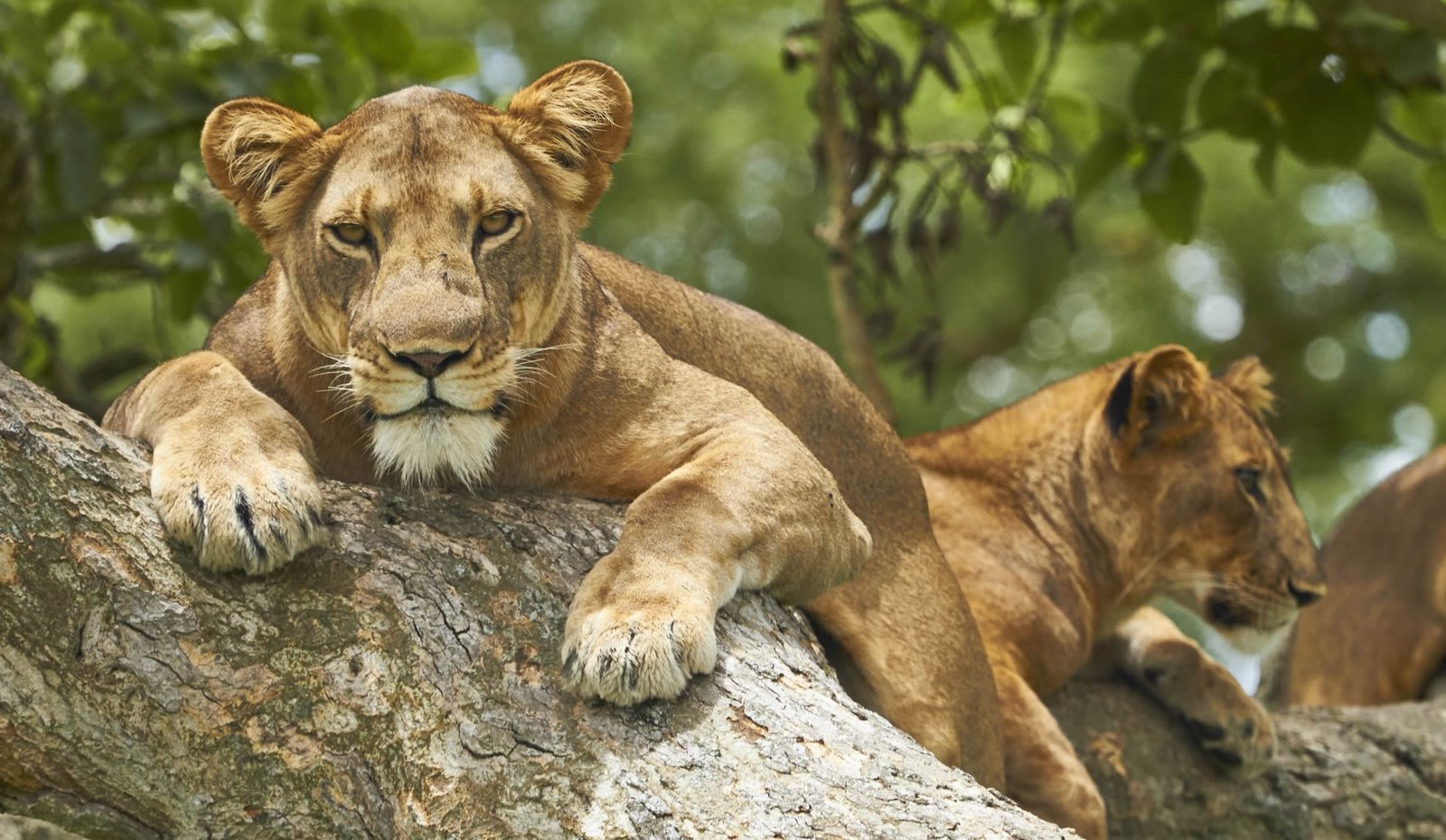
The Ishasha tree-climbing lions The Ishasha sector in the southern part of Queen Elizabeth National Park is one of only two places in East Africa where lions habitually climb trees — resting in the branches of large fig trees overlooking the open savanna. The tree-climbing behaviour is well-established and reliably observable — an extraordinary and unique wildlife encounter.
Perfect combination with Bwindi gorilla trekking Queen Elizabeth National Park is just 90 km from Bwindi Impenetrable Forest — making it the perfect companion destination for gorilla trekking. The combination of gorilla trekking in Bwindi and the Kazinga Channel boat safari in Queen Elizabeth is Uganda’s most popular safari pairing — two completely different and equally extraordinary wildlife experiences within 2 hours of each other.
“For the perfect circuit addition read our Lake Mburo National Park guide — the ideal stopover between Kampala and Queen Elizabeth.”
Wildlife in Queen Elizabeth Park
Lions — The Ishasha Tree-Climbers
The Ishasha sector of Queen Elizabeth National Park is home to one of Africa’s most celebrated and most unusual wildlife behaviours — tree-climbing lions.
The Ishasha lions regularly climb and rest in the branches of large fig trees (Ficus natalensis) — sometimes at heights of 6–8 metres — apparently to escape biting insects access cooling breezes and gain vantage points over the open savanna below.
The behaviour is well-established in Ishasha — multiple prides are habituated to vehicles and the tree-climbing behaviour is reliably observed particularly in the morning and late afternoon when lions seek shade in the largest fig trees along the Ishasha River.
Key Ishasha lion viewing tips:
- Focus your search on the large fig trees along the Ishasha River — the most consistent tree-climbing location
- Early morning (6:00–9:00am) and late afternoon (3:00–6:00pm) are best
- Look for tails hanging below the branches — the easiest way to spot a lion in a tree from a distance
- The Ishasha sector is 120 km south of the main Mweya peninsula — allow time to drive there and back
Beyond Ishasha Queen Elizabeth National Park has good lion populations throughout the northern sectors — particularly around the Kasenyi Plains area which offers excellent open savanna lion viewing.
Elephants
Queen Elizabeth National Park supports a significant elephant population — large herds regularly encountered on game drives in the Kasenyi and Mweya areas. The elephants are well-habituated to vehicles and often approach at close range.
The park has historically had challenging elephant-community conflict issues as elephants move outside park boundaries — an important conservation challenge that the Uganda Wildlife Authority works continuously to address.
Hippos
Queen Elizabeth National Park has one of Africa’s highest hippo concentrations — particularly in the Kazinga Channel and the lakes. The Kazinga Channel boat safari reveals hippo pods of extraordinary size — sometimes 50–80 animals visible in a single pool — at remarkably close range.
The hippos of Queen Elizabeth National Park are completely habituated to boats — allowing the Kazinga Channel boat to drift within metres of enormous pods of wallowing yawning hippos in a display of wildlife intimacy that is simply extraordinary.
Nile Crocodiles
The Kazinga Channel and both lakes support large populations of Nile crocodiles — some exceeding 4 metres in length. The boat safari drifts past basking crocodiles on the channel banks in extraordinary close-up — among the closest crocodile encounters available anywhere in Africa.
Buffalos
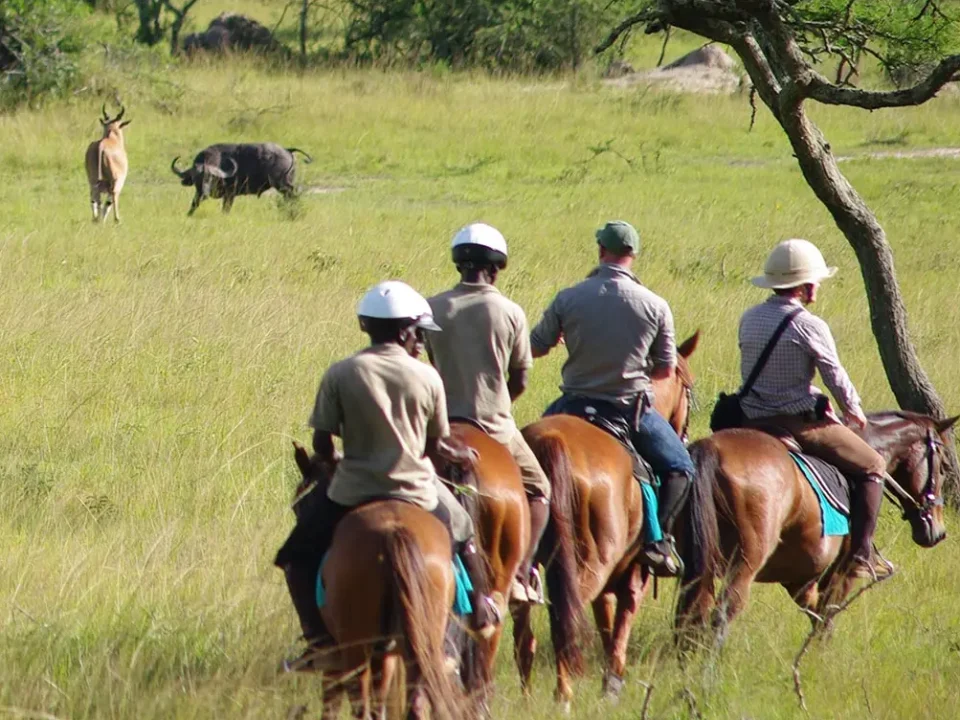
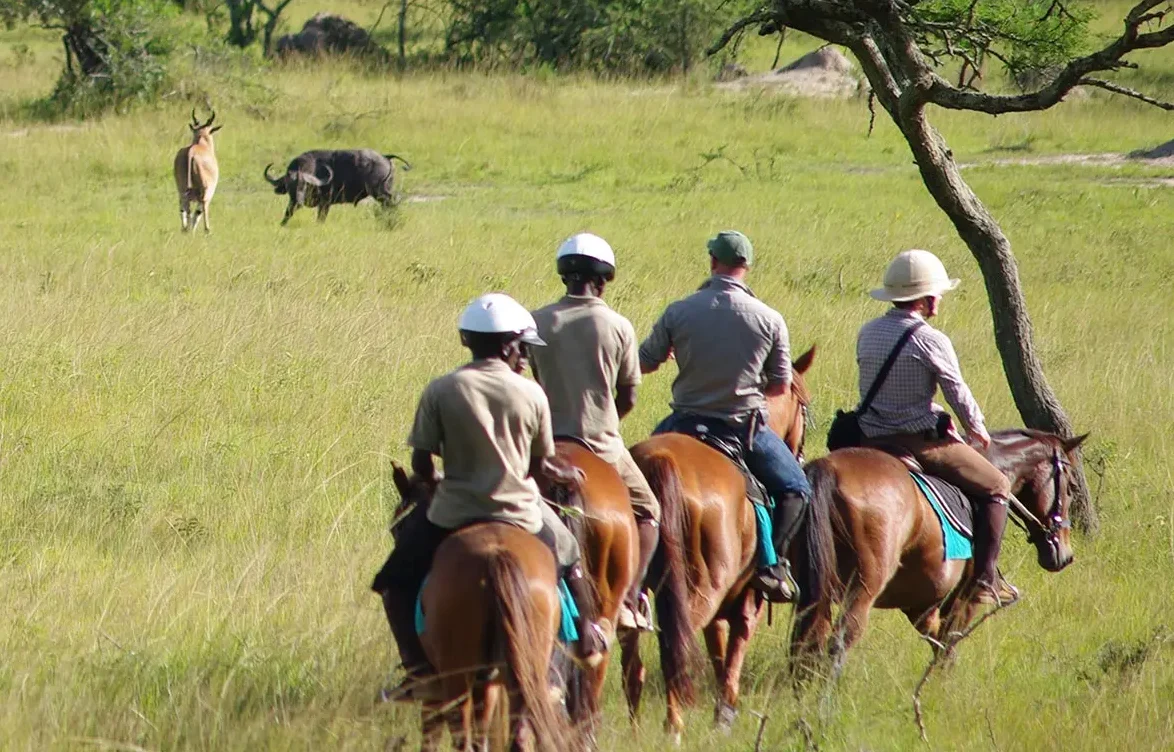
Large buffalo herds — sometimes hundreds of animals — are common throughout Queen Elizabeth National Park particularly in the Kasenyi area and along the Kazinga Channel banks. The Ishasha sector also has significant buffalo populations that are primary prey for the tree-climbing lion prides.
Leopards
Present throughout Queen Elizabeth National Park but as always elusive. The most reliable leopard zones are the Kasenyi area and the forested sections around Mweya Peninsula. Night drives (available in some private conservancy areas adjacent to the park) significantly improve leopard sighting chances.
Uganda Kob
The Uganda kob — a beautiful medium-sized antelope — is Uganda’s national animal and extremely abundant throughout Queen Elizabeth National Park. Large herds of Uganda kob on the open savanna are one of the park’s most characteristic sights — and as the primary prey species for the park’s lions are always worth watching for predator activity nearby.
Topis
The topi — a larger reddish-brown antelope with distinctive blue-black patches on the legs — is common on the open grasslands of Queen Elizabeth National Park and one of its most attractive and photogenic resident species.
Warthogs
Ubiquitous and entertaining throughout Queen Elizabeth National Park — warthog families trotting across the savanna with tails held straight up are one of the park’s most characteristically African sights.
Chimpanzees — Kyambura Gorge
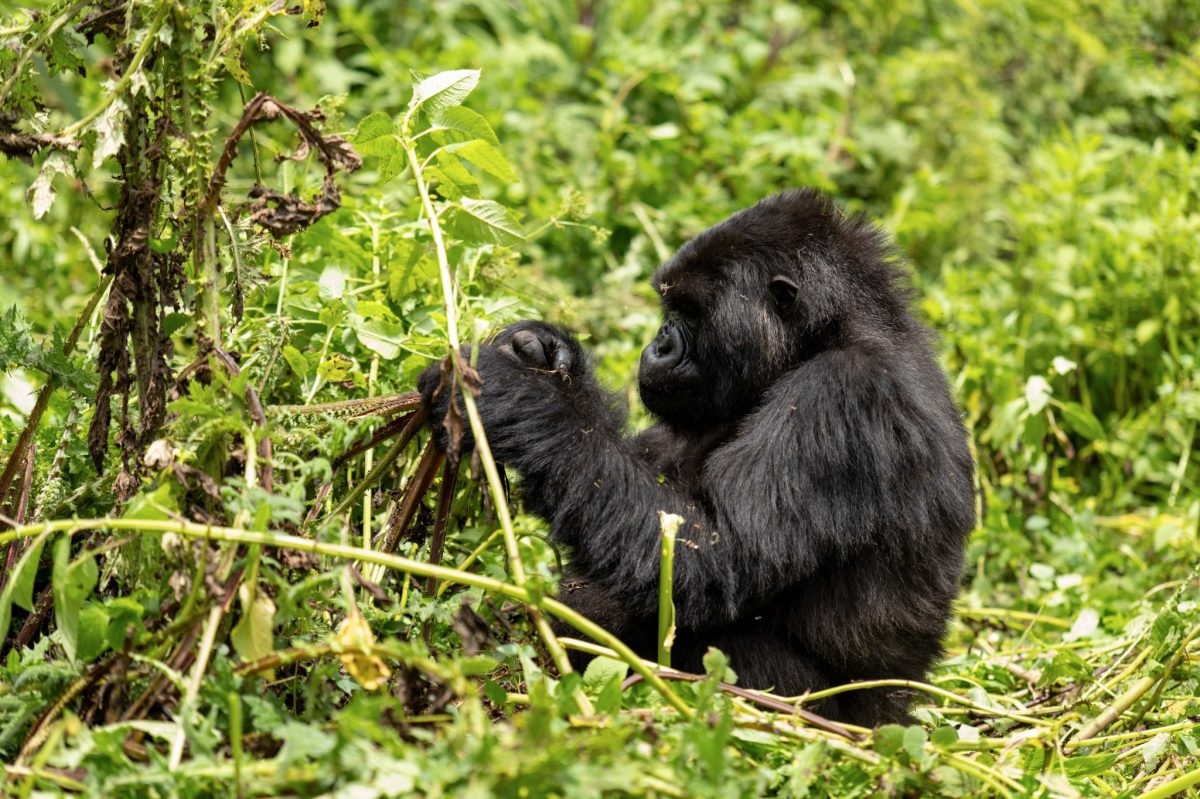
One of Queen Elizabeth National Park’s most extraordinary and most photogenic wildlife experiences is chimpanzee trekking in Kyambura Gorge — a dramatic forested gorge that cuts 100 metres deep into the open savanna in the northeastern park.
The gorge is home to a small habituated chimpanzee community of approximately 16 individuals — making Kyambura Gorge chimp trekking one of the most intimate chimpanzee experiences available in Uganda. The dramatic setting — descending into a deep forested gorge surrounded by open savanna — makes Kyambura Gorge visually extraordinary.
Kyambura Gorge chimpanzee trekking details:
- Permit cost: $50 USD per person
- Duration: 2–3 hours
- Group size: Maximum 6 people
- Departure: Kyambura Gorge trailhead (30 minutes from Mweya)
- Community size: Approximately 16 individuals — very small and intimate
For the most comprehensive chimpanzee trekking experience in Uganda Kibale Forest National Park (1,500 chimpanzees) is the superior destination. But Kyambura Gorge offers a uniquely atmospheric and intimate chimpanzee encounter that many travellers prefer for its dramatic setting and exclusivity. Read our complete chimpanzee trekking Kibale Forest guide.
The Kazinga Channel Boat Safari — The Highlight of Queen Elizabeth National Park
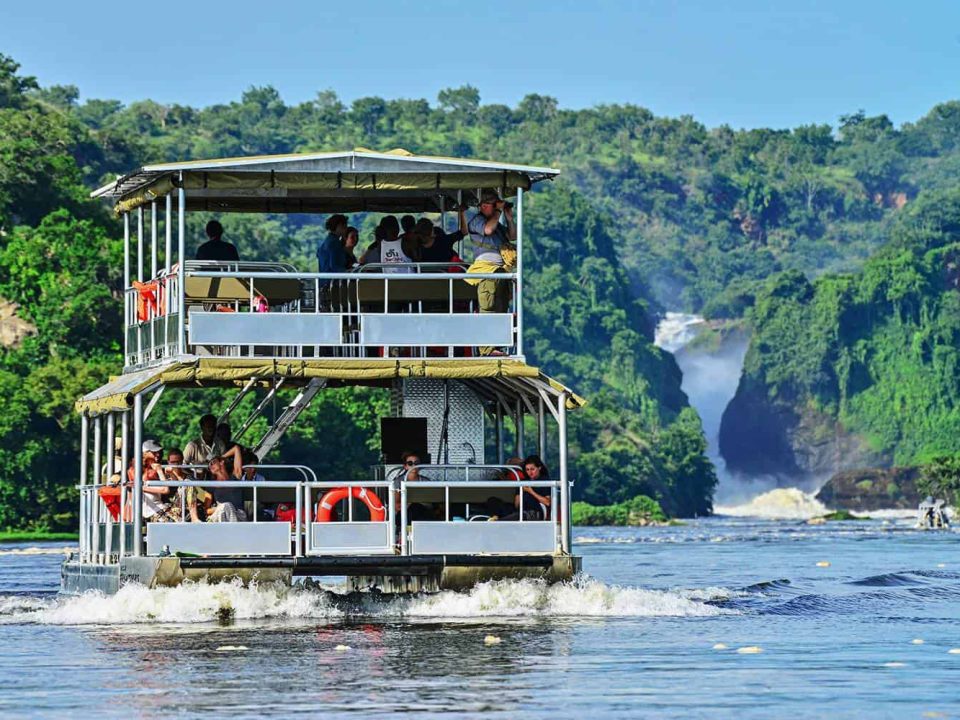
The Kazinga Channel boat safari is the single most celebrated activity in Queen Elizabeth National Park — and one of the finest wildlife boat experiences available anywhere in East Africa.
The Kazinga Channel is a 32 km natural waterway connecting Lake George (north) and Lake Edward (south) through the heart of Queen Elizabeth National Park. The channel banks support extraordinary concentrations of wildlife — drawn to the permanent water year-round — and the boat safari drifts slowly along the shoreline at incredibly close range to some of Africa’s most spectacular and abundant wildlife.
What You See on the Kazinga Channel Boat Safari
Hippos — the Kazinga Channel is one of Africa’s great hippo sanctuaries. Pods of 40–80 hippos are common along the boat route — yawning displaying territorial behaviour and occasionally mock-charging boats. The proximity is extraordinary — sometimes within 5 metres of enormous animals.
Nile crocodiles — large crocodiles basking on every exposed bank throughout the route. Some of the finest close-range crocodile photography in East Africa.
African fish eagles — calling and diving for fish throughout the journey — one of the most iconic sounds and sights of the African safari.
Elephants — frequently come to drink and bathe along the channel banks during the boat safari — sometimes in large breeding herds.
Buffalos — large herds on the grassland above the channel banks.
Water monitor lizards — common on the channel banks — large and prehistoric-looking.
Waterbirds — extraordinary diversity along the channel banks. Yellow-billed storks marabou storks African spoonbills sacred ibis goliath herons pied kingfishers malachite kingfishers saddle-billed storks and dozens of other species.
Kazinga Channel Boat Safari Details
Duration: 2 hours Departure times: 9:00am and 3:00pm (most common) Departure point: Mweya Safari Lodge jetty Cost: $30 USD per person Group size: Shared boat — typically 20–30 passengers
Private boat option: For a more exclusive experience private boat hire is available through lodges at additional cost. Contact Go Safaris Africa for private boat arrangements.
Best time: The 3:00pm departure is generally preferred — afternoon light is better for photography and wildlife is more active as temperatures cool.
Birdwatching in Queen Elizabeth National Park
Queen Elizabeth National Park is one of Africa’s premier birding destinations with over 612 recorded species — one of the highest counts of any national park in the world. The park’s extraordinary habitat diversity — savanna woodland crater lakes papyrus swamp and the Kazinga Channel — creates a birding experience of exceptional variety.
Key Species
Shoebill stork — one of Africa’s most sought-after birds and one of the most extraordinary-looking creatures in the animal kingdom. Queen Elizabeth National Park’s papyrus swamps — particularly the Katwe area and the northern Lake George papyrus — are among Uganda’s best shoebill locations. Canoe trips into the papyrus specifically targeting shoebill are available through specialist guides.
African skimmer — spectacular low-level flight over the Kazinga Channel — one of Africa’s most elegant and most photogenic waterbirds.
Pink-backed pelicans — large colonies along the Kazinga Channel banks.
African pygmy goose — small beautiful duck found on open water throughout the park.
Martial eagle — Africa’s largest eagle — occasionally soaring over the open savanna.
Yellow-billed oxpecker — common on large mammals throughout the park.
Papyrus gonolek — beautiful red and black papyrus specialist — vocal and occasionally visible at papyrus edges.
Lesser flamingo — seasonal visitor to the crater lakes — spectacular pink flocks on the alkaline water.
The Crater Lakes Circuit — Birding Paradise
Queen Elizabeth National Park contains a remarkable series of explosion craters in the Bunyaruguru and Katwe areas — small perfectly circular lakes surrounded by forested crater walls. These crater lakes are outstanding for birding — particularly for papyrus specialists and a wide variety of waterbirds.
The Crater Lakes Circuit — a scenic drive through the crater landscape west of the main park — is one of the most beautiful and most rewarding drives in Queen Elizabeth National Park for birders and photographers.
Game Drives in Queen Elizabeth National Park
Main Game Drive Areas
Kasenyi Plains (Northern Sector) The most productive game drive area in the northern Queen Elizabeth National Park — open short grass plains that are prime habitat for Uganda kob lion and cheetah. The Kasenyi area is where most lion activity is recorded in the northern sector.
Mweya Peninsula The Mweya Peninsula — home to the main lodge and park headquarters — is surrounded by the Kazinga Channel and offers excellent short game drive options with frequent elephant hippo and waterbird sightings.
Ishasha Sector (Southern Sector) The Ishasha sector 120 km south of Mweya is the exclusive home of Queen Elizabeth National Park’s tree-climbing lions. Game drives in Ishasha focus primarily on finding lions in fig trees along the Ishasha River.
The drive from Mweya to Ishasha takes approximately 2 hours — making an Ishasha game drive a full day commitment from the main park area. Many travellers base themselves at Ishasha Wilderness Camp specifically to maximise time in the southern sector.
Maramagambo Forest A large forest block in the eastern park — home to chimpanzees (unhabituated — not for trekking) forest elephants and extraordinary birding including the African crowned eagle and great blue turaco.
Game Drive Timing
Dawn game drive (6:00am–10:00am): Best for lions — particularly in the Kasenyi plains where pride activity peaks in the cool morning hours.
Late afternoon game drive (3:00pm–7:00pm): Excellent for predator activity and for large elephant herds coming to the Kazinga Channel to drink. Best combined with the 3:00pm boat safari — game drive in the morning boat safari in the afternoon.
Night game drives: Available on private conservancy areas adjacent to Queen Elizabeth National Park — revealing leopards bush babies civets and other nocturnal wildlife.
Best Time to Visit Queen Elizabeth National Park
Dry Season — June to September and December to February ⭐⭐⭐⭐⭐
The best overall time for Queen Elizabeth National Park. Dry trails easy game driving excellent wildlife viewing and the most reliable tree-climbing lion sightings in Ishasha. The Kazinga Channel boat safari is outstanding year-round but particularly good in dry season when animals concentrate at water.
June–September is peak season — coinciding with Bwindi gorilla trekking peak season. Book accommodation well in advance.
Wet Season — March to May and October to November ⭐⭐⭐
Heavier rainfall makes some tracks muddy. However:
- The Kazinga Channel boat safari is unaffected by rain
- Wildlife is present year-round
- Birding is exceptional — migrants arrive and breeding activity peaks
- Lodge rates drop 20–30%
- Far fewer other vehicles in the park
Wet season Queen Elizabeth National Park with a private vehicle can be a more exclusive and rewarding experience than peak season with more vehicles on the tracks.
For the complete Uganda seasonal guide read our Uganda travel guide 2026.
Where to Stay in Queen Elizabeth National Park
Luxury ($300–$800+ per person per night)
Mweya Safari Lodge ⭐⭐⭐⭐⭐ The flagship lodge of Queen Elizabeth National Park — beautifully positioned on the Mweya Peninsula overlooking the Kazinga Channel with panoramic views of Lake Edward and the Rwenzori Mountains. 52 rooms cottages and bandas with swimming pool excellent restaurant and the best location in the park.
Elephants hippos and waterbirds are visible from the lodge grounds throughout the day. The Kazinga Channel boat safari departs from the Mweya jetty directly below the lodge.
Price: $350–$600 per person per night full board
Kyambura Gorge Lodge ⭐⭐⭐⭐⭐ Asilia Africa’s extraordinary lodge perched on the rim of Kyambura Gorge with views down into the forested gorge where chimpanzees live below. Solar-powered stunning design exceptional cuisine and the most visually dramatic location of any Queen Elizabeth National Park lodge.
Chimpanzee trekking gorge walks community visits and game drives all available from the lodge.
Price: $400–$700 per person per night all-inclusive
Ishasha Wilderness Camp ⭐⭐⭐⭐ The finest accommodation in the Ishasha sector — perfectly positioned for tree-climbing lion viewing. 8 spacious tents along the Ishasha River beautiful food and expert guides who know every fig tree in the sector.
Staying at Ishasha Wilderness Camp maximises your tree-climbing lion viewing time — morning and evening game drives from camp without the 2-hour drive from Mweya.
Price: $300–$500 per person per night full board
Mid-Range ($150–$300 per person per night)
Elephant Plains Lodge Comfortable mid-range lodge near Mweya with good game drive access and reasonable prices. Good value for Queen Elizabeth National Park safari.
Enganzi Game Lodge Well-located mid-range property with good facilities and a warm welcoming atmosphere. Excellent value.
Jacana Safari Lodge Comfortable lodge in a beautiful location with good service and reliable wildlife access.
Budget ($50–$150 per person per night)
Mweya Hostel Uganda Wildlife Authority’s own budget accommodation on the Mweya Peninsula — basic but well-located. The most affordable accommodation with direct park access.
Simba Safari Camp Budget tented camp near the park with basic but adequate facilities. Popular with budget travellers and overlanders.
Getting to Queen Elizabeth Park
By Road from Kampala (5–6 hours)
Queen Elizabeth National Park is 410 km from Kampala — approximately 5–6 hours by road via Mbarara. The road is tarmac throughout — one of Uganda’s best road routes. A comfortable and scenic drive through the Ugandan highlands.
Go Safaris Africa provides comfortable 4×4 transfers as part of all Uganda safari packages.
By Domestic Flight (Strongly Recommended)
Kasese airstrip receives domestic flights from Entebbe (approximately 45 minutes) — eliminating the long road journey and arriving in time for an afternoon game drive or boat safari.
Flights also connect Kasese with Kihihi airstrip (near Bwindi) in approximately 30 minutes — making the Queen Elizabeth-Bwindi combination extremely efficient by air.
Combining with Bwindi Gorilla Trekking (Most Popular)
The most popular Uganda safari combination — Queen Elizabeth National Park and Bwindi Impenetrable Forest gorilla trekking — is only 90 km apart by road (approximately 2 hours).
Classic Uganda combination: Day 1: Arrive Entebbe → fly to Kasese → Mweya afternoon game drive Day 2: Kazinga Channel boat safari + Kasenyi game drive Day 3: Drive to Ishasha sector → tree-climbing lion game drive Day 4: Drive to Bwindi (2 hours from Ishasha) → afternoon forest walk Day 5: Gorilla trekking Bwindi Impenetrable Forest Day 6: Transfer to Lake Bunyonyi → relaxation Day 7: Return Entebbe → depart
This 7-day itinerary is the essential Uganda safari experience — combining the country’s finest game viewing waterway safari and gorilla trekking into one extraordinary week.
Read our 10-day Uganda safari itinerary for the complete extended Uganda circuit and our Uganda gorilla permit guide for gorilla permit booking details.
QENP Costs
Park Fees
- Adult entry: $45 USD per person per day
- Vehicle fee: $40 USD per vehicle per day
- Kazinga Channel boat safari: $30 USD per person
- Kyambura Gorge chimpanzee permit: $50 USD per person
Total Safari Costs
| Safari Level | Cost Per Person Per Day |
|---|---|
| Budget | $150–$250 |
| Mid-range | $250–$400 |
| Luxury | $400–$800 |
| Ultra-luxury | $600–$1,500+ |
Typical 3-night Queen Elizabeth safari total:
- Budget: $600–$900 per person
- Mid-range: $900–$1,500 per person
- Luxury: $1,500–$3,000 per person
Book Your Queen Elizabeth Safari with Go Safaris Africa
Go Safaris Africa plans and operates Queen Elizabeth National Park safaris as part of complete Uganda safari itineraries — combining game drives the Kazinga Channel boat safari Ishasha tree-climbing lions and Kyambura Gorge chimpanzees with gorilla trekking in Bwindi for the ultimate Uganda wildlife experience.
- 👉 View Uganda safari packages
- 👉 View our 10-day Uganda safari itinerary
- 👉 Uganda gorilla permit complete guide
- 👉 Bwindi Impenetrable Forest complete guide
- 👉 Contact us for a free Uganda safari quote
📞 Call or WhatsApp: +250 788 365 595 📧 info@gosafarisafrica.com 🌐 www.gosafarisafrica.com
Frequently Asked Questions
What is Queen Elizabeth National Park famous for? Queen Elizabeth National Park is famous for its tree-climbing lions in the Ishasha sector the extraordinary Kazinga Channel boat safari with hippos and crocodiles at close range and its exceptional biodiversity with 95 mammal species and 612 bird species. It is Uganda’s most visited and most diverse national park.
Where are the tree-climbing lions in Queen Elizabeth National Park? The tree-climbing lions are in the Ishasha sector in the southern part of Queen Elizabeth National Park — approximately 120 km south of the main Mweya area. They are most commonly seen resting in fig trees along the Ishasha River in the early morning and late afternoon.
What is the Kazinga Channel boat safari? A 2-hour boat trip along the 32 km waterway connecting Lake George and Lake Edward — revealing extraordinary concentrations of hippos crocodiles elephants waterbirds and other wildlife at remarkably close range. One of the finest wildlife boat experiences in East Africa. Cost: $30 per person.
When is the best time to visit Queen Elizabeth National Park? June–September and December–February offer the best conditions — dry tracks excellent wildlife viewing and the most reliable tree-climbing lion sightings. The park is rewarding year-round. Read our Uganda travel guide for the complete seasonal breakdown.
Can I combine Queen Elizabeth National Park with gorilla trekking? Absolutely — this is Uganda’s most popular safari combination. Queen Elizabeth National Park is just 90 km from Bwindi Impenetrable Forest. Read our Uganda gorilla permit guide for gorilla booking details and our 10-day Uganda safari itinerary for the complete combined route.
Does Queen Elizabeth National Park have chimpanzees? Yes — Kyambura Gorge in the northeastern park has a small habituated chimpanzee community of approximately 16 individuals. Kyambura Gorge chimpanzee trekking costs $50 per person. For the finest chimpanzee trekking in Uganda read our Kibale Forest chimpanzee guide.
How do I get to Queen Elizabeth National Park? 5–6 hours by road from Kampala or a 45-minute domestic flight from Entebbe to Kasese airstrip. Go Safaris Africa arranges all transfers as part of Uganda safari packages.
Is Queen Elizabeth National Park good for birding? Exceptionally — 612 recorded species make it one of the most biodiverse birding national parks in the world. Key species include the shoebill stork African skimmer African pygmy goose martial eagle and dozens of papyrus specialists. See our complete birding guide above.
Go Safaris Africa is a Kigali-based safari operator specialising in gorilla trekking wildlife safaris and tailor-made adventures across Rwanda Uganda Kenya and Tanzania. 📍 Prince House Second Floor Office #5 Kigali Rwanda 📞 +250 788 365 595 | 🌐 www.gosafarisafrica.com