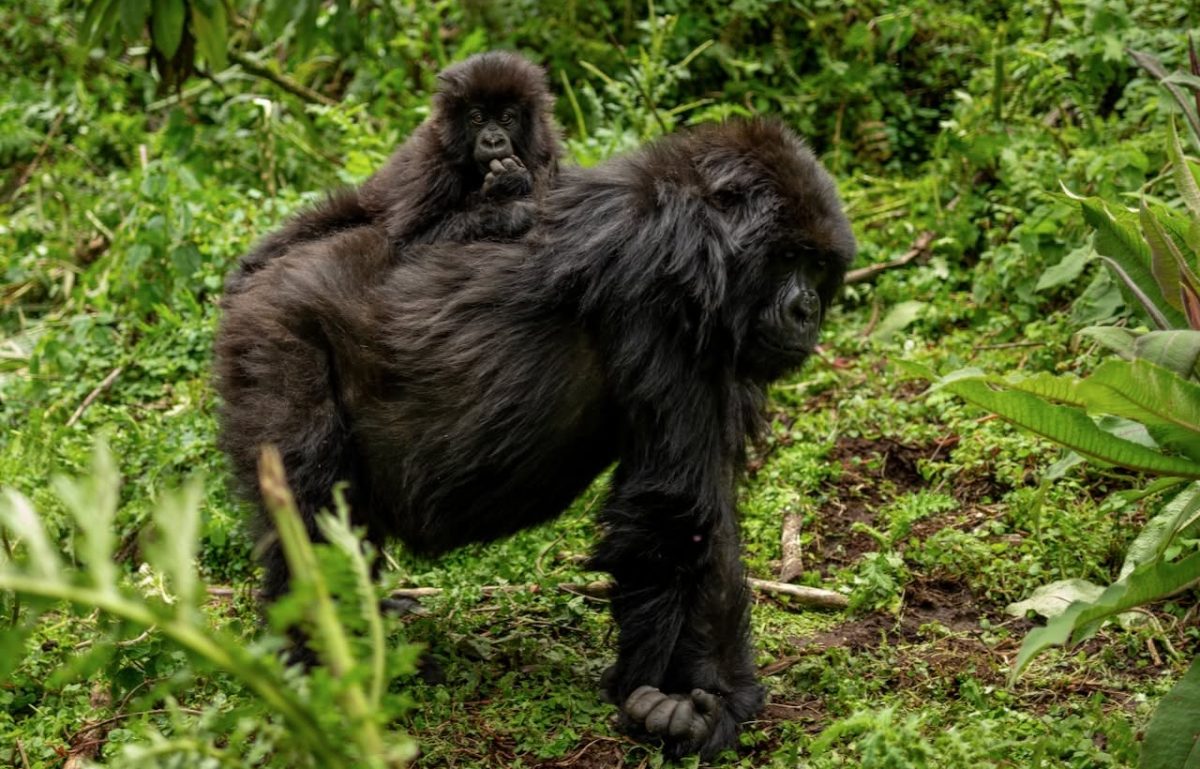

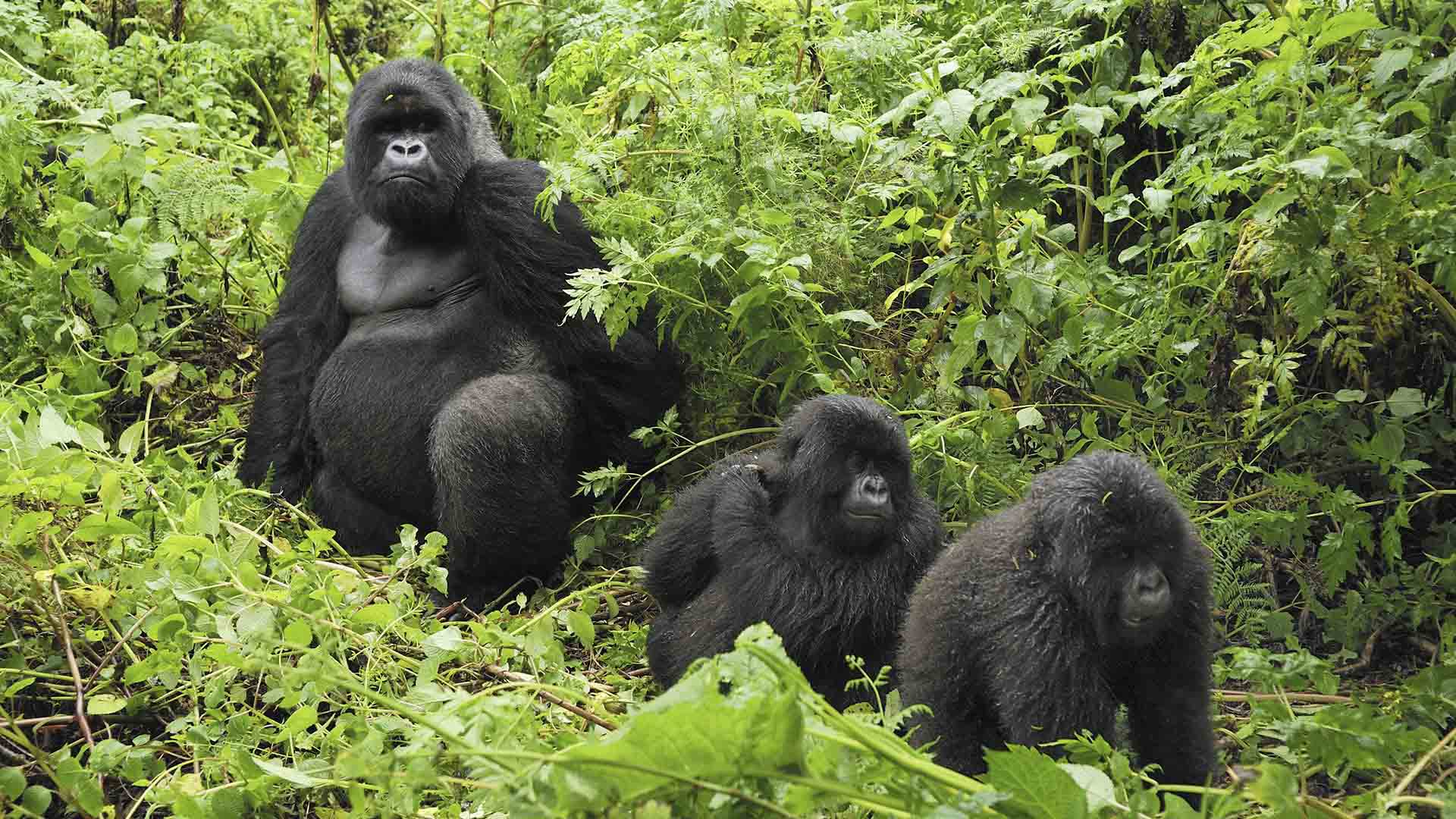
What Is Gorilla Trekking Like? You’ve seen the photographs. A silverback, mid-yawn, jaw wide open. A mother nursing a tiny infant under a canopy of giant hagenia trees. A young gorilla swinging from a vine within arm’s reach of a frozen, speechless tourist.
No photograph explains what gorilla trekking is actually like to experience.
This guide does. If you’ve never trekked for gorillas before, this is exactly what to expect — from the 5am briefing at park headquarters to the moment a 200kg silverback turns and looks directly at you, to the drive back to Kigali replaying the morning in your head.
The Short Answer — What Is Gorilla Trekking?
Gorilla trekking is a guided hike through mountain rainforest to find and spend time with a habituated family of wild mountain gorillas. There are roughly 1,000 mountain gorillas left on Earth — all of them living in a single forested arc spanning the volcanoes of Rwanda, Uganda, and the Democratic Republic of Congo.
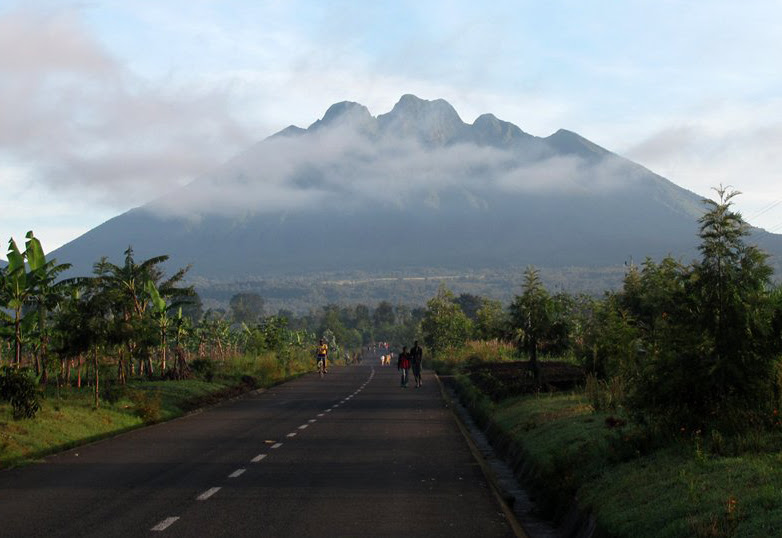
In Rwanda, trekking takes place in Volcanoes National Park — a chain of six volcanoes covered in Afromontane forest, rising to over 4,500 metres above sea level.
A Rwanda gorilla trekking permit is issued by the Rwanda Development Board and covers one trek, one gorilla family, and one hour in their presence. That one hour is what every trekker spends up to six hours of hiking to earn.
The experience is not a zoo, not a reserve, and not a game drive. It is an encounter with wild animals in their natural habitat, made possible only because those specific gorilla families have been habituated — gradually introduced to human presence over years — by trained researchers and park guides.
The Full Gorilla Trekking Day — Hour by Hour
5:00am — The Drive From Your Lodge
Most trekkers stay the night before at a lodge in Musanze (the nearest town to Volcanoes National Park) or at a property on the slopes of the Virunga volcanoes themselves. Your operator will have arranged accommodation at the right distance.
Breakfast is early — typically 5:00–5:30am. The drive to park headquarters at Kinigi takes 15–30 minutes depending on where you’re staying.
7:00am — Briefing at Park Headquarters
All trekkers gather at Kinigi headquarters for a briefing. This is where the day officially begins.
Rangers assign each trekking group to one of the habituated gorilla families. Rwanda currently has around 12 habituated gorilla groups open for tourism. Groups range in size from smaller families of 7–8 to large groups of 20+ individuals.
The briefing covers:
- Rules of conduct inside the forest (no flash photography, stay 7 metres from the gorillas, no eating or drinking near them, face masks required if you feel unwell)
- What to expect on the trail
- Physical difficulty level for today’s trek to your assigned group
- Porter availability
Groups are limited to 8 visitors per gorilla family per day — a strict rule enforced by Rwanda Development Board, one of the most rigorous permit systems in Africa.
8:00am — The Trek Begins
You enter the forest from the edge of the cultivated farmland that borders the park boundary. The transition is immediate — from potato fields to dense bamboo to Afromontane forest within minutes.
Trekking can be between 90 minutes and 6 hours, depending on the gorilla family assigned and where they are located that morning.
The terrain in Volcanoes National Park is volcanic — uneven, steep in sections, and often muddy after rain. The altitude ranges from roughly 2,400m at the forest edge to 3,000m+ in higher sections. First-timers frequently underestimate the physical demand. This is a real hike, not a gentle nature walk.
What you’ll notice on the trail:
- The silence. Once you’re deep in the forest, sounds from outside disappear. What replaces them is birdsong, the creak of giant trees, the distant thud of something large moving through undergrowth.
- The guide’s communication. Your park guide will periodically receive radio calls from trackers who went ahead at dawn to locate the gorilla family before you even arrived at headquarters.
- The pace. Good guides set a sustainable pace. If you’re struggling, say so. The goal is to arrive at the gorilla family without being exhausted.
The Moment of Contact
This is the part no guide can prepare you for.
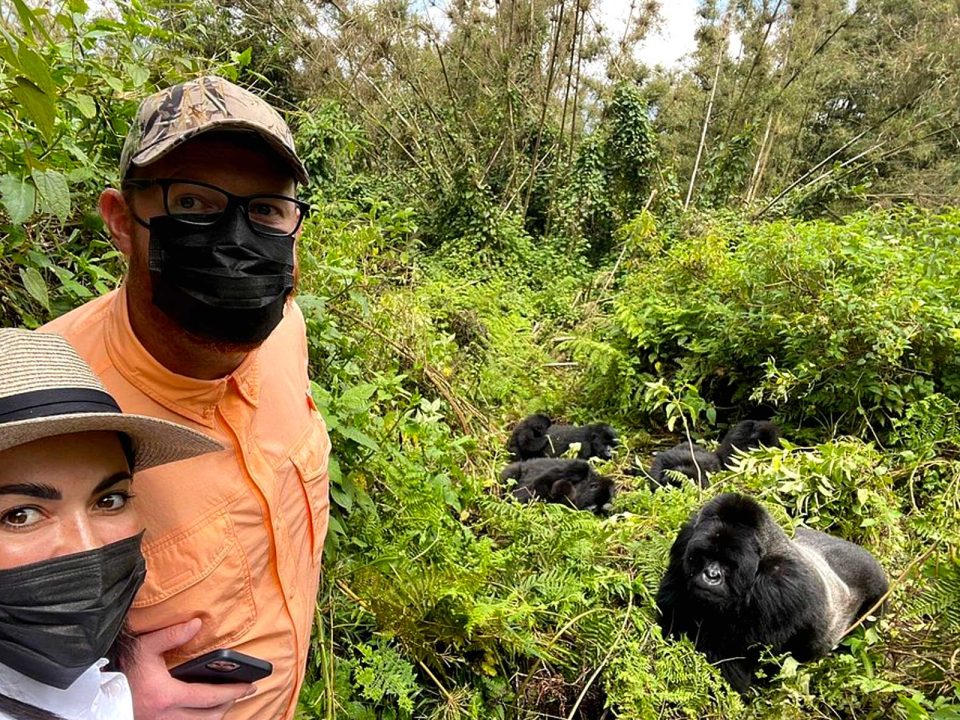
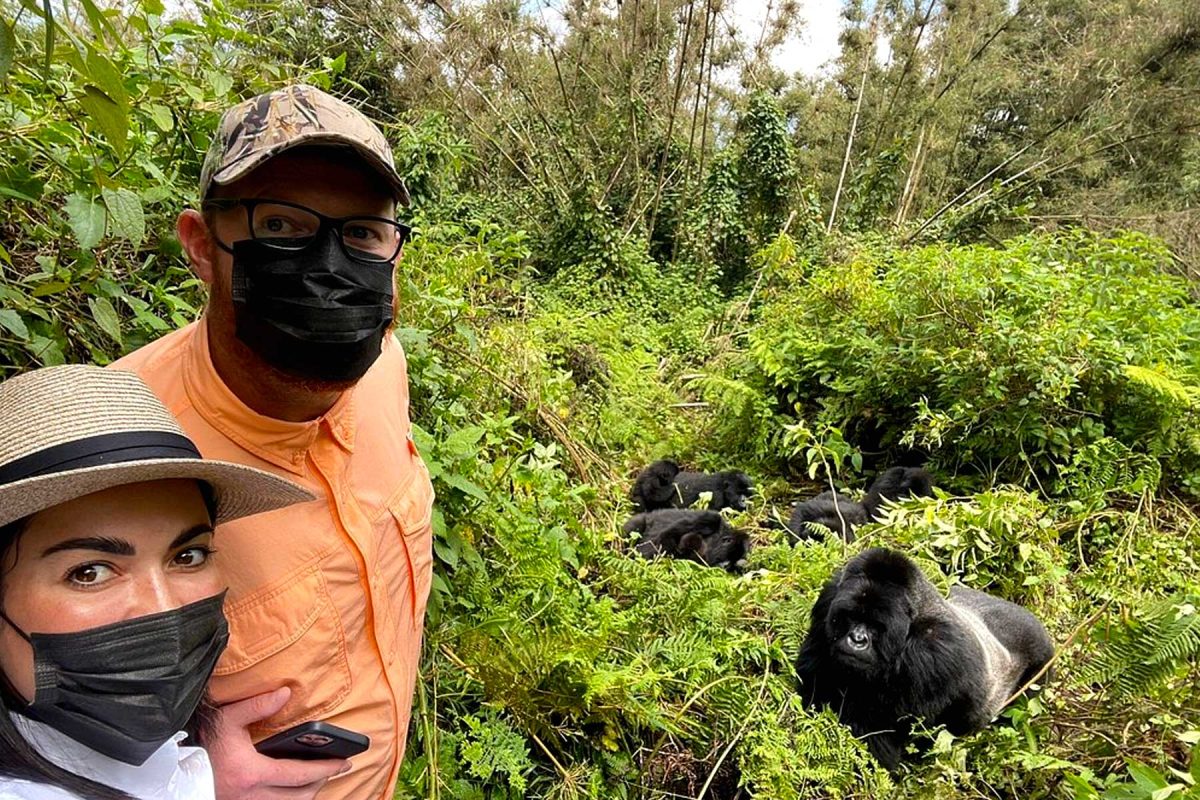
The trackers radio that the family is close. Your guide signals silence. You put away your water bottle, check your camera is ready, and step slowly into a small clearing — or squeeze between two massive tree trunks — and there they are.
Most first-timers describe a moment of complete disorientation. Your brain is processing something it has no reference point for: an animal the size of a grown man, with a face of extraordinary expressiveness, sitting 10 metres away doing something completely ordinary — eating, grooming, watching a juvenile play. The silverback may glance at you briefly and return to whatever he was doing. Or he may hold your gaze for a long, unreadable moment.
You are permitted to stay for one hour.
The Hour With the Gorilla Family
The hour you spend with the gorilla family is not structured — there is no stage direction, no feeding schedule, no path the animals follow for your benefit.
What typically happens:
- The family moves slowly through vegetation, feeding on wild celery, bamboo shoots, and nettles
- Juveniles play — chasing each other, tumbling over adults, occasionally swinging into view directly above your group
- The silverback rests, watches, and occasionally repositions — when he moves, you move out of his path
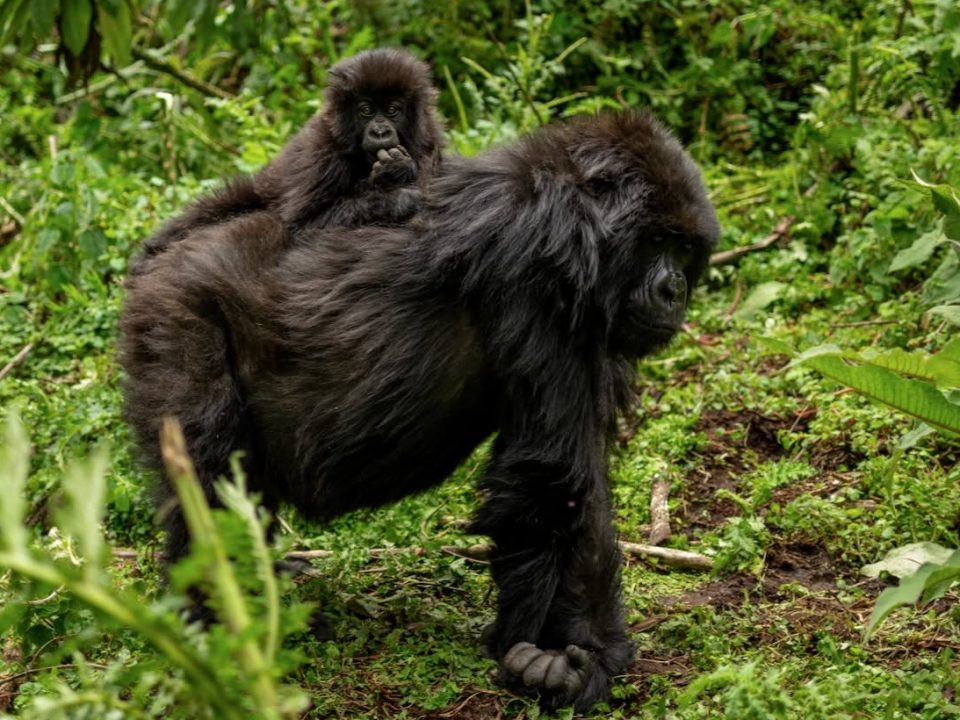
- Mothers nurse or carry infants close to their chests
- Blackbacks (young adult males) hover at the group’s edge
Your guide narrates quietly — this is Titus, the dominant silverback, he has 11 children; that female with the infant is Makali, she was born in this group 14 years ago. The names make it real. These are individuals with histories.
The hour passes extraordinarily quickly. Almost every trekker reports the same thing: they look at their watch and cannot believe it.
The Hike Out
After exactly one hour, your guide signals the end of the encounter. You retrace your steps — or take a different route if the gorillas have moved — back to the forest edge.
The hike out is typically easier, partly because it’s often downhill, partly because adrenaline has been replaced by something quieter. Groups tend to walk in near-silence, processing what just happened.
You receive your gorilla trekking certificate at park headquarters — a formal document confirming the date, the gorilla family name, and the names of your guide and trackers.
Back in Kigali by Afternoon
If you’re on a day-trip from Kigali with Go Safaris Africa, your driver meets you at the park gate for the return transfer. You’re typically back in Kigali by 3–5pm, depending on trek duration.
For clients combining gorilla trekking with a wider Rwanda itinerary, the afternoon is free for lodge rest, golden monkey trekking (also in Volcanoes National Park), or exploring Musanze before the next morning’s activities.
What Surprises First-Timers Most
After years of arranging gorilla treks from Kigali, the Go Safaris Africa team hears the same first-timer reactions. These are the things that catch people off guard:
The gorillas are bigger than expected. Even people who have researched mountain gorillas extensively are not prepared for a 200kg silverback in person. The sheer physical presence — the breadth of the chest, the size of the hands, the height when he stands briefly — is startling.
How close they come. The 7-metre rule is a guideline, not a guarantee. Gorillas move where they choose. It is not uncommon for a juvenile to wander within 2–3 metres. When this happens, your guide signals you to stay still and not make eye contact with the animal. The juvenile will usually move on without incident.
The emotional response. People cry. Serious, composed adults who expected to find the experience remarkable cry during or after the encounter. Something about the proximity to an animal so genetically similar to us — and so visibly individual in personality — bypasses normal emotional filters. This is worth knowing in advance so you’re not surprised by your own reaction.
The physical difficulty. First-timers with modest fitness are often caught off guard by the terrain. The altitude, the uneven ground, the mud — particularly after rain — make sections of the trek genuinely challenging. This is why we always recommend hiring a porter.
How fast the hour goes. Every trekker reports this. The hour feels like 10 minutes.
Gorilla Trekking Difficulty — Am I Fit Enough?
This is the question we receive most often from first-time trekkers.
The honest answer: gorilla trekking is not a walk in the park, but it is also not mountaineering. The physical demand sits somewhere between a challenging countryside walk and a mountain hike. If you can walk for 2–4 hours on uneven terrain, you can trek for gorillas.
Volcanoes National Park sits at altitude, and the ascent into the forest will raise your heart rate. Take it slowly, drink water, and communicate with your guide if you need to slow the pace.
Factors that affect difficulty:
- Which gorilla family you’re assigned (groups higher on the mountain mean longer, steeper treks)
- Recent weather (mud and rain make the trail harder)
- Your altitude acclimatisation (arriving in Rwanda the day before from sea level, you will feel the altitude on the first morning)
Our strong recommendation: hire a porter.
Porters are local community members employed through the park’s official porter programme. They carry your bag, assist you on steep or muddy sections, and significantly reduce the physical toll of the trek. The porter fee is typically $15–20, and the tip you leave at the end of the day goes directly to a local family. Hiring a porter is one of the most meaningful ways your trek contributes to the communities living beside the park.
What to Wear and Bring for Gorilla Trekking
Clothing:
- Long-sleeved shirt and long trousers (protects against nettles, insects, and cold)
- Waterproof jacket or rain poncho (conditions can change quickly at altitude)
- Sturdy, waterproof hiking boots with ankle support — non-negotiable
- Gardening gloves or light hiking gloves (for gripping vegetation on steep sections)
- Gaiters (optional but useful in muddy conditions)
What to carry:
- 1.5–2 litres of water minimum
- Light snack (energy bar, fruit — do not eat near the gorillas)
- Camera — no flash, fully charged
- Small daypack (your porter will carry it)
- Sunscreen and insect repellent
What not to bring:
- Perfume or strong-smelling products (can disturb the gorillas)
- Bright colours (not prohibited, but neutral/dark colours are preferred)
- Anything you can’t carry comfortably for 4–6 hours
The Best Time of Year for Gorilla Trekking in Rwanda
Gorilla trekking is a year-round activity. Every season offers a different quality of experience.
Rwanda has two dry seasons and two wet seasons:
June–September (long dry season) — Peak season
Best weather, clearest trails, easiest trekking conditions. The most popular and most booked period. Permits and accommodation for these months sell out 6–12 months in advance.
December–January (short dry season) — High season
Good conditions, slightly fewer visitors than June–September. Popular with European and American travellers on holiday.
March–May (long wet season)
Lush, atmospheric, fewer visitors, often lower accommodation rates. The forest is dramatic in the rain. Trails are muddier but trekking is fully operational.
October–November (short wet season)
Similar to March–May. Fewer trekkers, good availability, and striking misty forest conditions.
There is no wrong time to trek. We arrange gorilla treks year-round from Kigali. Contact Go Safaris Africa to check permit availability for your specific dates.
Gorilla Trekking Rwanda vs Uganda — How the Experience Differs
Both countries offer extraordinary gorilla encounters. The experience differs in a few meaningful ways:
Rwanda — Volcanoes National Park: shorter transfer from Kigali International Airport, wide range of accommodation from mid-range to ultra-luxury, and terrain that is demanding but generally accessible. The forest has an open, volcanic character — wide-trunked hagenia trees, bamboo zones, and open clearings. Read our full comparison: Bwindi vs Volcanoes National Park — Which Is Better?
Uganda — Bwindi Impenetrable Forest: a wilder, denser forest experience with more varied terrain. Uganda also offers the gorilla habituation experience, which allows four hours with a semi-habituated gorilla family rather than one hour.
For trekkers who want to experience both, Go Safaris Africa designs combined Rwanda and Uganda itineraries. See our multi-country safari options.
Frequently Asked Questions
Q: Can I go gorilla trekking if I’m not physically fit?
Moderate fitness is required, but most people without specific physical limitations can complete a gorilla trek. The key is pacing — go slowly, hire a porter, and communicate with your guide. If you have a specific health concern, contact us before booking and we can advise on which gorilla families have shorter, flatter routes.
Q: Is gorilla trekking safe?
Yes. Habituated gorilla families are accustomed to small groups of humans. Incidents are extremely rare. Park guides are trained professionals who read gorilla behaviour and position your group appropriately. Standard rules — no flash photography, maintain 7-metre distance, follow guide instructions immediately — keep both trekkers and gorillas safe.
Q: Can children go gorilla trekking?
Rwanda Development Board requires trekkers to be a minimum of 15 years old. This rule is firm and not waivable.
Q: What happens if the gorillas come very close?
Your guide will signal you to stay still, crouch slightly, and avoid direct eye contact. Do not run. The guide positions the group and manages the encounter. Direct contact is extremely rare and guides are trained to prevent it.
Q: Will I definitely see gorillas?
Yes. Rwanda’s habituation system means trackers locate the gorilla family before trekkers set out. In the extremely rare event a family cannot be found, Rwanda Development Board will rebook your permit at no additional cost.
Q: How many people trek together?
A maximum of 8 visitors per gorilla family per day. This is enforced without exception and is one reason Rwanda’s gorilla trekking experience feels intimate rather than crowded.
Q: How do I book a gorilla trek?
We handle everything — permits, transfer from Kigali, accommodation, guides, and porters. Read our full step-by-step guide: How to Book a Gorilla Trekking Permit in Rwanda. Or contact us directly to get started.
Ready to Plan Your Gorilla Trek?
Go Safaris Africa has been arranging gorilla treks from Kigali since 2010. We know Volcanoes National Park, we know the Rwanda Development Board permit system, and we know what makes the difference between a memorable gorilla encounter and a stressful one.
We handle permits, transfers, accommodation, guides, and porter arrangements — everything between your hotel in Kigali and the moment you step into the forest.
Contact us to check permit availability for your dates and receive a personalised gorilla trekking itinerary.
📧 info@gosafarisafrica.com
📞 +250 788365595
🌐 gosafarisafrica.com
Go Safaris Africa is a licensed Rwanda tour operator registered with Rwanda Development Board, based in Kigali since 2010.