
A Uganda safari itinerary of 10 days is the perfect length to experience the very best this extraordinary and underrated country has to offer. Uganda is one of Africa’s most diverse and rewarding safari destinations — home to mountain gorillas, chimpanzees, tree-climbing lions, shoebill storks, vast savanna plains, crater lakes, and some of the most dramatic landscapes on the African continent.
Yet Uganda remains far less visited than Kenya or Tanzania — meaning more exclusive experiences, less crowded parks, and a rawer, more authentic Africa than you find in the most heavily touristed safari destinations.
This complete Uganda safari itinerary covers 10 extraordinary days — gorilla trekking in Bwindi Impenetrable Forest, chimpanzee trekking in Kibale Forest, game drives and boat safaris in Queen Elizabeth National Park, and the breathtaking scenery of Lake Bunyonyi. Designed by the expert team at Go Safaris Africa — your local East Africa safari specialists.
“For complete Uganda trip planning read our Uganda travel guide 2026 covering visas safety money transport and practical information.”
Why Uganda Deserves 10 Days
Uganda is often called the Pearl of Africa — a name coined by Winston Churchill who visited in 1907 and was overwhelmed by the country’s extraordinary biodiversity and landscape beauty. A decade later, the name still fits perfectly.
In 10 days a Uganda safari itinerary allows you to experience:
- Mountain gorilla trekking — Bwindi Impenetrable Forest, the greatest gorilla habitat on Earth
- Chimpanzee trekking — Kibale Forest, the best chimp trekking destination in Africa
- Big Five game drives — Queen Elizabeth National Park with its famous tree-climbing lions
- Boat safaris — the Kazinga Channel, one of Africa’s best waterway wildlife experiences
- Crater lakes — the beautiful Fort Portal crater lake region
- Lake Bunyonyi — one of Africa’s most beautiful lakes, perfect for relaxation after trekking
- Cultural experiences — Batwa pygmy communities, local village visits, traditional dance
No other country in East Africa offers this concentration of different primate, wildlife, and landscape experiences in a single 10-day journey.
10-Day Uganda Safari Itinerary Overview
| Day | Location | Main Activity |
|---|---|---|
| Day 1 | Entebbe/Kampala | Arrival + city orientation |
| Day 2 | Kibale Forest | Transfer + afternoon nature walk |
| Day 3 | Kibale Forest | Chimpanzee trekking |
| Day 4 | Queen Elizabeth NP | Transfer + afternoon game drive |
| Day 5 | Queen Elizabeth NP | Morning game drive + Kazinga Channel boat safari |
| Day 6 | Bwindi Impenetrable Forest | Transfer via Ishasha |
| Day 7 | Bwindi Impenetrable Forest | Gorilla trekking |
| Day 8 | Bwindi/Lake Bunyonyi | Morning activity + Lake Bunyonyi |
| Day 9 | Lake Bunyonyi/Kigali | Relaxation + cross to Rwanda (optional) |
| Day 10 | Entebbe/Kigali | Departure |
Day-by-Day Uganda Safari Itinerary
Day 1 — Arrive Entebbe: Welcome to the Pearl of Africa
Location: Entebbe / Kampala Accommodation: Entebbe or Kampala hotel (budget $50–$100 / mid-range $100–$200 / luxury $200–$400)
Your Uganda safari itinerary begins at Entebbe International Airport — Uganda’s main international gateway sitting on the shores of Lake Victoria, just 40 kilometres from Kampala.
Your Go Safaris Africa driver-guide meets you at arrivals and transfers you to your hotel in Entebbe or Kampala.
Afternoon — Entebbe Options
If you arrive with time and energy, Entebbe offers several wonderful first-day activities:
Uganda Wildlife Education Centre (UWEC) A world-class wildlife centre on the shores of Lake Victoria — home to rescued and rehabilitated wildlife including chimpanzees, lions, rhinos, giraffes, and hundreds of bird species. An excellent introduction to Uganda’s wildlife before heading into the field. Entry approximately $20.
Entebbe Botanical Gardens Historic botanical gardens on the Lake Victoria shore — famous as a filming location for several Tarzan movies. Beautiful lake views, enormous fig trees, and abundant birdlife. Grey-crowned cranes, African fish eagles, and kingfishers are easily spotted.
Lake Victoria Boat Trip A late afternoon boat trip on Africa’s largest lake — watching the sun set over Lake Victoria with fishing boats returning to shore is a magical introduction to Uganda.
Evening: Dinner at your hotel or one of Entebbe’s excellent restaurants. Your guide briefs you on the full 10-day Uganda safari itinerary ahead.
Day 2 — Transfer to Kibale Forest: The Primate Capital of the World
Location: Kibale Forest National Park Accommodation: Lodge near Kibale Forest (budget $60–$100 / mid-range $120–$250 / luxury $300–$600) Drive: Entebbe/Kampala to Kibale — approximately 5–6 hours
Morning — Departure and Scenic Drive
After breakfast your driver-guide departs for Kibale Forest National Park in western Uganda. The 5–6 hour drive passes through Kampala, climbs into the highlands of western Uganda, and descends through tea plantations and equatorial forest to Fort Portal — the gateway town to Kibale.
The drive itself is a Uganda experience — colourful roadside markets, boda-boda motorcycle taxis weaving through traffic, children waving from school compounds, and the landscape gradually shifting from suburban sprawl to lush highland forest.
Fort Portal Crater Lakes (En Route Stop)
Fort Portal is surrounded by a remarkable landscape of volcanic crater lakes — over 50 small lakes nestled in ancient calderas, each surrounded by tea plantations, community forests, and small farms. A short detour to the Ndali-Kasenda crater lake area is one of the most beautiful stops on any Uganda safari itinerary. Pack a picnic lunch and eat overlooking the lakes.
Afternoon — Kibale Forest Arrival and Nature Walk
Arrive at your Kibale Forest lodge by mid-afternoon. After checking in, an afternoon guided nature walk through the forest edge introduces you to Kibale’s extraordinary biodiversity — red-tailed monkeys, L’Hoest’s monkeys, black and white colobus monkeys, and dozens of forest bird species are commonly seen on afternoon walks.
Your guide briefs you on tomorrow’s chimpanzee trek — what to expect, what to wear, and the tracking rules.
“For the complete Lake Mburo stopover guide read our Lake Mburo National Park visitor guide.”
Day 3 — Chimpanzee Trekking: The Best in Africa
Location: Kibale Forest National Park Accommodation: Same lodge as Day 2 Highlight: Face to face with wild chimpanzees in their natural forest habitat
Kibale Forest National Park is home to approximately 1,500 chimpanzees — the highest density of chimpanzees anywhere in East Africa — making it the undisputed best destination for chimpanzee trekking on the African continent.
7:00am: Chimpanzee trek briefing at Kanyanchu Visitor Centre.
Rules for chimpanzee trekking are similar to gorilla trekking — maintain distance, no flash photography, no trekking if you are ill, maximum 8 people per chimpanzee community per session.
The Trek
Chimpanzee trekking in Kibale is a completely different experience from gorilla trekking — faster, louder, more chaotic, and in many ways even more thrilling. Chimpanzees share 98.7% of human DNA — the closest living relatives to humans. Watching them is watching a distorted mirror of ourselves.
The Kibale chimps are extraordinarily active — they move fast through the forest canopy, chase each other through the trees, groom each other with intense concentration, and make the forest ring with their extraordinary vocalisations. The deep whooping calls that build to a crescendo — the famous chimp drumming on tree buttresses — is one of the most extraordinary sounds in nature.
You spend one hour with the chimpanzee community — moving with them through the forest as they forage, socialise, and go about their extraordinary lives.
Afternoon — Bigodi Wetland Sanctuary
The afternoon of Day 3 brings one of the hidden gems of any Uganda safari itinerary — Bigodi Wetland Sanctuary, a community-managed papyrus swamp adjacent to Kibale Forest.
Bigodi is one of Uganda’s premier birding destinations — over 200 bird species in a compact, walkable area. But the real draw is primates — eight primate species including red colobus monkeys, mangabeys, and olive baboons are commonly seen on the 3-hour guided walk through the swamp.
Entry fees go directly to the local community — one of Uganda’s finest examples of conservation tourism benefiting local people.
“For the complete chimpanzee trekking guide read our chimpanzee trekking Kibale Forest complete guide.”
Day 4 — Transfer to Queen Elizabeth National Park
Location: Queen Elizabeth National Park Accommodation: Lodge in Queen Elizabeth NP (budget $80–$150 / mid-range $150–$300 / luxury $350–$800) Drive: Kibale to Queen Elizabeth — approximately 3–4 hours
Morning — Scenic Transfer
After breakfast depart Kibale for Queen Elizabeth National Park — Uganda’s most visited national park and one of East Africa’s most biodiverse wildlife destinations.
The drive south from Kibale passes through the beautiful Rwenzori mountain foothills — the legendary Mountains of the Moon that form the border between Uganda and DRC. On clear mornings the snow-capped peaks of Mount Stanley (5,109m — Africa’s third highest mountain) are visible above the clouds.
Equator Crossing
En route to Queen Elizabeth National Park your Uganda safari itinerary crosses the equator — a moment worth celebrating. Your driver stops at the equator monument where you can stand simultaneously in both the northern and southern hemispheres and watch the famous Coriolis effect water demonstration.
Afternoon Game Drive — Queen Elizabeth National Park
Arrive at Queen Elizabeth National Park in time for a late afternoon game drive — the best time for wildlife activity in the park’s open savanna.
Queen Elizabeth National Park covers 1,978 km² of diverse habitats — open savanna, acacia woodland, wetlands, and the shores of Lakes Edward and George. It supports an extraordinary diversity of wildlife:
- African elephants — large herds throughout the park
- African buffalos — massive herds on the open plains
- Hippos — extraordinarily abundant in the Kazinga Channel
- Nile crocodiles — large specimens on the channel banks
- Uganda kob — the national animal of Uganda, abundant everywhere
- Topi and waterbuck — elegant antelope species on the plains
- Warthogs — entertaining and ubiquitous
- Olive baboons — large troops at forest edges
- African leopards — present but elusive
- Lions — including the famous tree-climbing lions of Ishasha sector
Evening: Sundowner overlooking the Kazinga Channel or Lake Edward — one of the most beautiful sunsets of any Uganda safari itinerary.
“For the complete Queen Elizabeth guide read our Queen Elizabeth National Park visitor guide.”
Day 5 — Game Drive & Kazinga Channel Boat Safari
Location: Queen Elizabeth National Park Accommodation: Same lodge as Day 4 Highlight: Kazinga Channel boat safari — one of Africa’s best waterway experiences
5:30am — Dawn Game Drive
The best wildlife viewing of your Queen Elizabeth days happens in the first hour of daylight. Lions are most active before sunrise — your guide knows the pride territories and positions you for the best possible sightings.
The famous tree-climbing lions of Ishasha are found in the southern sector of Queen Elizabeth National Park — 2.5 hours from the main Kasenyi area. If seeing tree-climbing lions is a priority for your Uganda safari itinerary, discuss with your guide whether to spend Day 5 in Ishasha or combine it with the Kazinga Channel.
Morning — Kazinga Channel Boat Safari
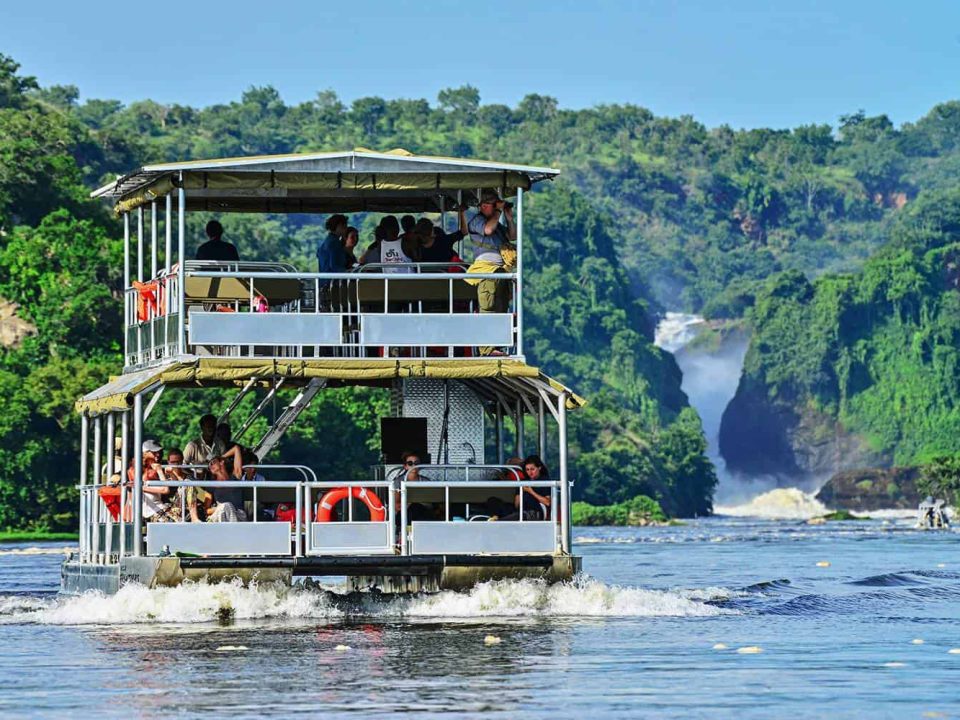
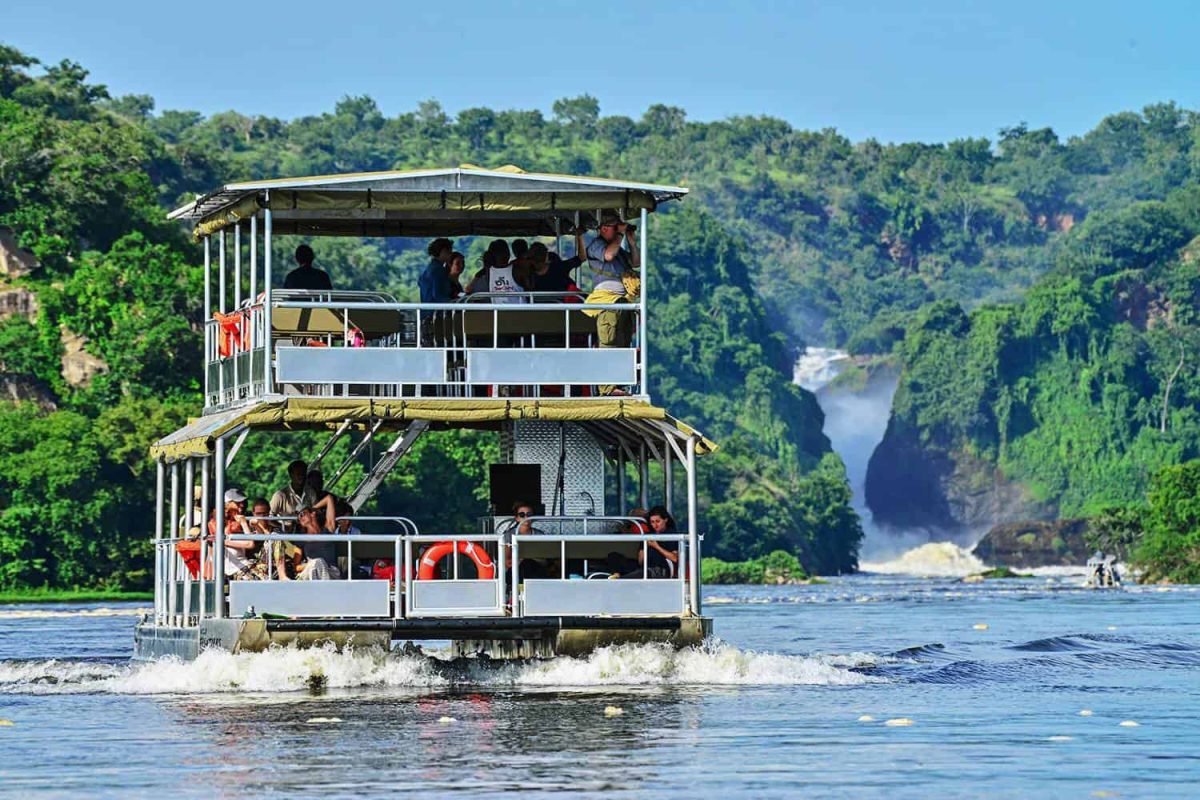
The Kazinga Channel — a 32-kilometre natural waterway connecting Lakes Edward and George — is home to one of the highest concentrations of hippos and Nile crocodiles in Africa and is the highlight of every Queen Elizabeth National Park visit.
The 2-hour boat safari departs from the channel jetty and drifts slowly along the waterway past:
- Hippo pods of 50–100 animals wallowing in the shallows just metres from the boat
- Nile crocodiles up to 4 metres long sunning on the banks
- African fish eagles diving for fish in spectacular aerial displays
- African skimmers racing low over the water surface
- Goliath herons — the world’s largest heron — standing motionless in the shallows
- Pied kingfishers hovering and diving in rapid succession
- Elephants drinking and bathing on the channel banks
- Buffalo herds coming down to drink in enormous numbers
The Kazinga Channel boat safari is one of the greatest wildlife experiences of any Uganda safari itinerary — and one of the most underrated wildlife boat trips in all of Africa.
Afternoon: Return to lodge for lunch. Afternoon game drive in the Kasenyi plains — excellent for lion prides, elephant herds, and Uganda kob breeding herds.
“For the complete Murchison Falls guide read our Murchison Falls National Park visitor guide.”
Day 6 — Transfer to Bwindi via Ishasha: Tree-Climbing Lions
Location: Bwindi Impenetrable Forest Accommodation: Lodge near Bwindi (budget $60–$120 / mid-range $120–$300 / luxury $300–$700) Drive: Queen Elizabeth NP to Bwindi — approximately 4–5 hours via Ishasha Highlight: Ishasha tree-climbing lions en route
Day 6 of your Uganda safari itinerary combines a spectacular wildlife encounter with a scenic mountain drive — one of the best travel days of the entire journey.
Morning — Ishasha Tree-Climbing Lions
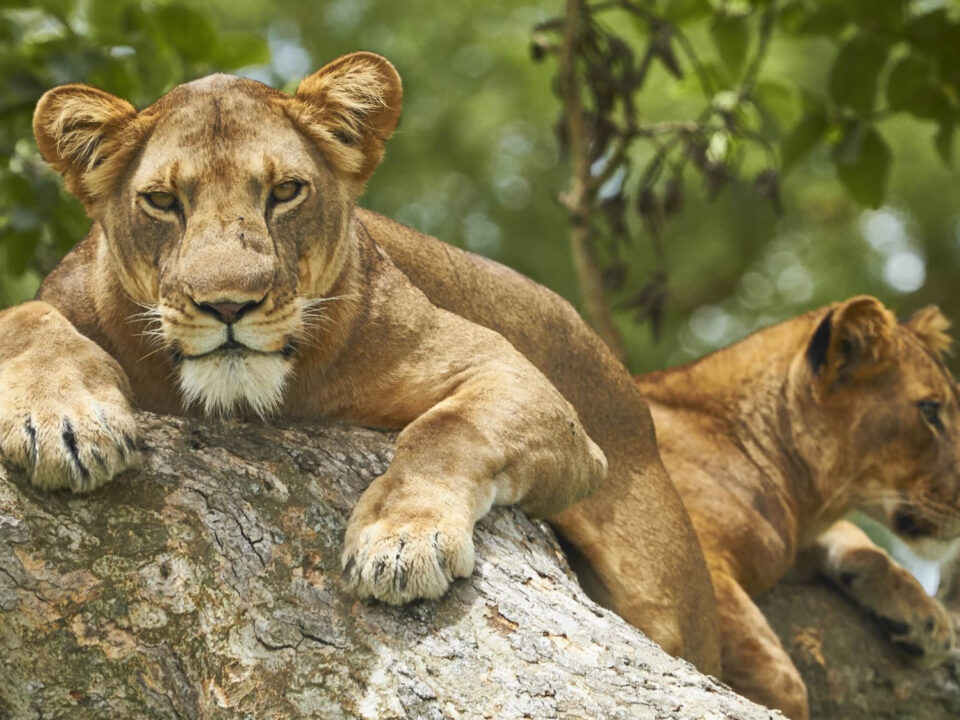
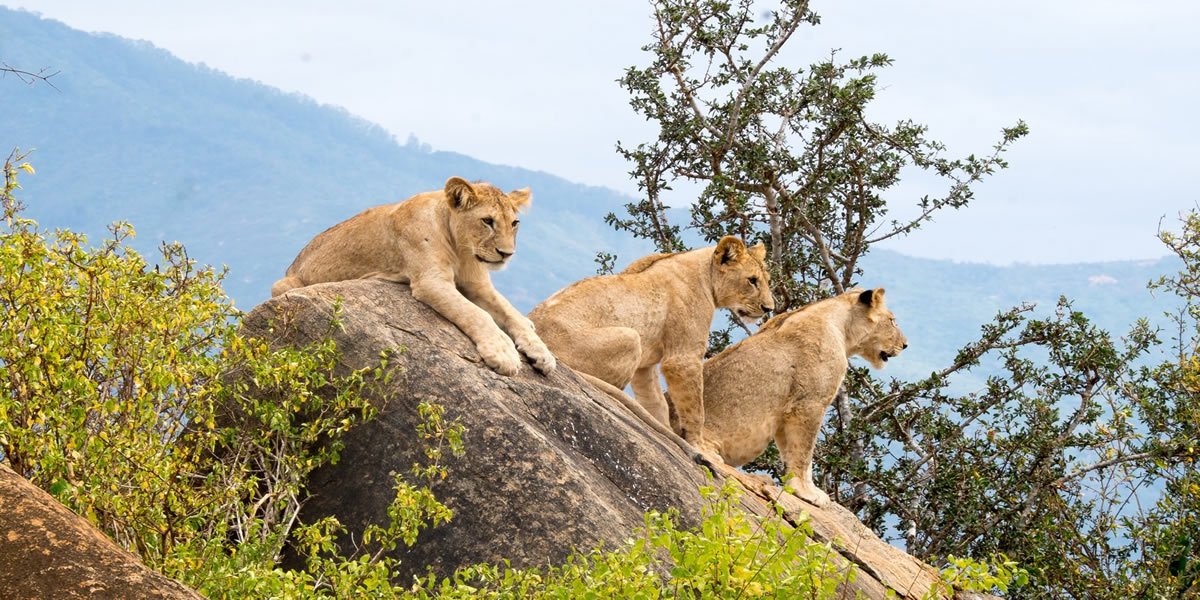
The route from Queen Elizabeth National Park to Bwindi passes through Ishasha sector in the southern part of the park — the only place in East Africa outside Tanzania’s Lake Manyara where lions habitually climb trees.
No one fully understands why Ishasha’s lions climb. The leading theories involve escaping the biting flies and insects that swarm at ground level, accessing cool breezes in the canopy, and gaining a vantage point to spot prey. Whatever the reason, the sight of a pride of lions lounging in the branches of a giant fig tree is one of the most remarkable and photogenic sights in all of Africa.
Your guide patrols the famous fig trees of Ishasha — particularly around the Ntungwe River area — searching for the resident lion prides. Sightings are not guaranteed but are very common, especially in the mornings.
Afternoon — Scenic Mountain Drive to Bwindi
After Ishasha the road climbs dramatically into the highlands of southwestern Uganda — one of the most beautiful drives on any Uganda safari itinerary. The landscape transforms from open savanna into terraced highland farmland, montane forest, and eventually the ancient dark hills of Bwindi.
Arrive at your Bwindi lodge by late afternoon. The forest sounds at dusk — primates calling, hornbills in the canopy, the first cicadas of evening — create an atmosphere completely unlike anywhere else in Uganda.
Evening: Dinner at your lodge. Your guide briefs you on tomorrow’s gorilla trek — the most anticipated day of your Uganda safari itinerary.
For full information on Bwindi read our complete Bwindi Impenetrable Forest visitor guide.
Day 7 — Gorilla Trekking: The Greatest Wildlife Encounter
Location: Bwindi Impenetrable Forest Accommodation: Same lodge as Day 6 Highlight: One hour with a wild mountain gorilla family
The day your entire Uganda safari itinerary has been building towards. Gorilla trekking in Bwindi Impenetrable Forest is the greatest wildlife experience in Uganda — and one of the most extraordinary wildlife encounters available anywhere on Earth.
7:00am: Gorilla trek briefing at your sector headquarters — Buhoma, Rushaga, Ruhija, or Nkuringo depending on which sector your Go Safaris Africa guide has booked your permit for.
“For the complete Uganda permit booking process read our Uganda gorilla permit guide.”
The Trek
Bwindi’s gorilla treks are generally more demanding than Rwanda’s Volcanoes National Park — the forest is denser, the terrain steeper, and treks can last up to 8 hours. Hiring a porter ($15–$20) is strongly recommended — they carry your daypack and provide invaluable assistance on steep, muddy sections.
But the difficulty is also part of what makes Bwindi special. This is ancient, wild, impenetrable rainforest — and finding a gorilla family within it feels like a genuine discovery rather than a managed experience.
The Encounter
One extraordinary hour with a mountain gorilla family. Read our gorilla trekking Rwanda vs Uganda guide for a full description of the gorilla encounter — no words fully capture it, but we try.
You receive your official gorilla trekking certificate after the trek — proof of one of the world’s truly great wildlife achievements.
Afternoon: Rest at your lodge. After a demanding gorilla trek most visitors simply want to sit on their lodge terrace, reflect on the morning, and enjoy the extraordinary forest sounds and views of Bwindi.
For full preparation guidance read our complete gorilla trekking packing list.
Day 8 — Batwa Cultural Experience & Lake Bunyonyi
Location: Bwindi → Lake Bunyonyi Accommodation: Lake Bunyonyi lodge (budget $50–$100 / mid-range $100–$250 / luxury $250–$500) Highlight: Batwa cultural experience + Lake Bunyonyi arrival
Morning — Batwa Pygmy Cultural Experience
The Batwa pygmies are the original forest people of Bwindi — hunter-gatherers who lived inside the forest for thousands of years before the national park was established in 1991. Their eviction from the forest was a painful and controversial chapter in Uganda’s conservation history.
Today the Batwa Trail offers visitors an extraordinary cultural experience — walking through the forest with Batwa guides who demonstrate their traditional forest skills: honey harvesting from wild beehives, medicinal plant identification, fire-making, hunting techniques, and traditional songs and dance.
The experience is deeply moving — a window into a way of life that has all but disappeared. Entry fees support the Batwa community directly.
Afternoon — Lake Bunyonyi
After the Batwa experience your driver-guide transfers you to Lake Bunyonyi — one of the most beautiful lakes in all of Africa.
Lake Bunyonyi sits at 1,962 metres above sea level in a deep valley surrounded by terraced hills in southwestern Uganda. Its name means “place of many little birds” — and the lake lives up to its name with over 200 bird species recorded including the African finfoot, papyrus gonolek, and dozens of waterbirds.
The lake is dotted with 29 small islands — some inhabited, some forested, some with community tourism facilities. The water is calm, clear, and safe for swimming — free of bilharzia and hippos, making it one of the few places in Uganda safe to swim.
Activities at Lake Bunyonyi:
- Dugout canoe trips to the islands
- Swimming in the clear lake water
- Birdwatching — over 200 species
- Village walks to local communities
- Simply sitting and absorbing the extraordinary peace
After the intensity of gorilla trekking, Bwindi forest, and Queen Elizabeth game drives, Lake Bunyonyi feels like paradise. Most travellers immediately wish they had booked more nights here.
Day 9 — Lake Bunyonyi Relaxation & Optional Rwanda Border Crossing
Location: Lake Bunyonyi → (Optional) Kigali, Rwanda Accommodation: Kigali hotel or continue at Lake Bunyonyi
Day 9 of your Uganda safari itinerary offers a wonderful choice — a final relaxation day at Lake Bunyonyi, or crossing the border into Rwanda to add gorilla trekking in Volcanoes National Park to your itinerary.
Option A — Relaxation Day at Lake Bunyonyi A morning kayak trip, afternoon island visit, and evening sundowner on the lake shore. Perfect for travellers who have done everything they came for and simply want to savour their last full day in Uganda.
Option B — Cross to Rwanda and Kigali The Rwanda border crossing at Katuna/Gatuna is approximately 1.5 hours from Lake Bunyonyi. Cross into Rwanda and drive to Kigali (3–4 hours total) — arriving in time for an evening in one of Africa’s finest capital cities.
This option is perfect for travellers who want to add Rwanda gorilla trekking to their Uganda safari itinerary — creating a combined Uganda and Rwanda primate safari that represents one of the world’s greatest wildlife journeys.
👉 Read our gorilla trekking Rwanda vs Uganda guide for the full comparison. 👉 See our 10-days Uganda and Rwanda safari package for the complete combined itinerary.
Day 10 — Departure from Entebbe or Kigali
Location: Entebbe International Airport or Kigali International Airport
Your final morning. Depending on your flight time, Day 10 offers one last opportunity to enjoy wherever you are — a final Lake Bunyonyi sunrise, a Kigali breakfast at Question Coffee, or a morning visit to the Entebbe Botanical Gardens before your transfer to the airport.
Your Go Safaris Africa driver-guide transfers you to Entebbe International Airport or Kigali International Airport for your departure flight.
Until next time, Pearl of Africa. 🦍
10-Day Uganda Safari Itinerary: Complete Cost Breakdown
| Item | Budget | Mid-Range | Luxury |
|---|---|---|---|
| Uganda gorilla permit | $800 | $800 | $800 |
| Chimpanzee permit (Kibale) | $200 | $200 | $200 |
| Accommodation (9 nights) | $630 | $1,800 | $5,400 |
| Safari vehicle + guide (10 days) | $1,000 | $1,300 | $1,800 |
| Kazinga Channel boat safari | $30 | $30 | $30 |
| Batwa Cultural Experience | $80 | $80 | $80 |
| Bigodi Wetland walk | $30 | $30 | $30 |
| Airport transfers | $100 | $150 | $250 |
| Porter — gorilla trek | $20 | $20 | $20 |
| Porter — chimp trek | $15 | $15 | $15 |
| Tips (guides, rangers, staff) | $150 | $200 | $350 |
| Meals (not lodge-included) | $300 | $150 | $0 |
| Total per person | ~$3,355 | ~$4,775 | ~$8,975 |
Costs are per person based on two people sharing. International flights not included. Domestic flight option (Entebbe to Kihihi): add approximately $350 per person each way.
Uganda Safari Itinerary: Key Practical Information
Getting to Uganda
Main airport: Entebbe International Airport (EBB) — on the shores of Lake Victoria, 40km from Kampala Direct flights from: London (British Airways, Uganda Airlines), Dubai (Emirates), Nairobi (Kenya Airways, Ethiopian), Amsterdam (KLM), Brussels (Brussels Airlines), Addis Ababa (Ethiopian Airlines)
Getting Around Uganda
A private 4×4 safari vehicle with an experienced driver-guide is the best and most flexible way to cover this Uganda safari itinerary. Go Safaris Africa provides well-maintained 4×4 vehicles for all our Uganda safaris.
Domestic flights are highly recommended for the Entebbe–Kibale and Bwindi–Entebbe legs if your budget allows. Flying saves 5–6 hours of road driving on each leg and allows more time in the parks.
Visa
Most nationalities require a Uganda visa — available as an e-visa online before travel ($50 USD). The East African Tourist Visa ($100 USD) covers Uganda, Rwanda, and Kenya — excellent value for this itinerary if crossing to Rwanda on Day 9.
Health
- Yellow fever vaccination mandatory for Uganda entry
- Antimalarial medication essential — consult your doctor 4–6 weeks before travel
- Travel insurance with medical evacuation coverage mandatory
- Comprehensive travel insurance covering gorilla and chimp trek cancellation strongly recommended
Best Time for This Uganda Safari Itinerary
June–September and December–February offer the best conditions across all parks. For a detailed seasonal breakdown read our best time to visit Rwanda for gorilla trekking guide — Uganda’s seasons follow identical patterns.
What to Pack
Read our complete gorilla trekking packing list — all recommendations apply equally to Uganda.
Customise Your Uganda Safari Itinerary
Every traveller is different. Go Safaris Africa tailors every Uganda safari itinerary to your specific interests:
Add Murchison Falls National Park Uganda’s largest national park in the northwest — home to the world’s most powerful waterfall, large Nile crocodiles, enormous hippo pods, giraffes, and shoebill storks. Add 3 days at the start of your itinerary departing from Entebbe north.
Add Rwanda Gorilla Trekking Cross into Rwanda after Lake Bunyonyi for gorilla trekking in Volcanoes National Park — creating one of the world’s greatest primate safari combinations. See our 10-days Uganda and Rwanda safari package.
Add Lake Mburo National Park Uganda’s most accessible national park — just 3 hours from Kampala. Zebras, impalas, topis, hippos, and hundreds of birds. Perfect add-on for a longer Uganda safari itinerary.
Gorilla Habituation Experience Replace the standard 1-hour gorilla trek with the extraordinary 4-hour Gorilla Habituation Experience in Bwindi’s Rushaga sector ($1,500 per person — maximum 4 people). The most intimate gorilla experience available anywhere. Read more in our Bwindi Impenetrable Forest guide.
Book Your Uganda Safari Itinerary with Go Safaris Africa
Go Safaris Africa is East Africa’s local safari specialist — based in Kigali with deep expertise across Uganda, Rwanda, Kenya, and Tanzania. When you book your Uganda safari itinerary with us:
- ✅ Gorilla and chimp permits secured — we book months in advance
- ✅ Expert local guides — our driver-guides know every park intimately
- ✅ Comfortable 4×4 vehicles — well-maintained safari vehicles throughout
- ✅ Fully flexible — we customise every itinerary to your interests
- ✅ Transparent pricing — no hidden fees, clear inclusions
- ✅ Responsible tourism — conservation and community support in everything we do
- ✅ 24/7 support — available before, during, and after your safari
- 👉 View our Uganda safari packages
- 👉 View our 10-days Uganda and Rwanda safari
- 👉 Book your Uganda gorilla permit
- 👉 Contact us for a free custom quote
📞 Call or WhatsApp: +250 788 365 595 📧 info@gosafarisafrica.com 🌐 www.gosafarisafrica.com
Frequently Asked Questions
How much does a 10-day Uganda safari cost? From approximately $3,355 per person on a budget to $8,975 per person on a luxury itinerary. See the complete cost breakdown above. Contact Go Safaris Africa for a precise quote based on your dates and preferences.
Is Uganda safe to visit in 2026? Yes — Uganda is a stable and welcoming country with a well-established tourism industry. Go Safaris Africa monitors security conditions continuously and our team is based in the region. Standard travel precautions apply as with any international destination.
Is Uganda better than Rwanda for gorilla trekking? Both are extraordinary — Uganda offers cheaper permits ($800 vs $1,500) and a more adventurous experience while Rwanda is more accessible and luxurious. Read our complete gorilla trekking Rwanda vs Uganda guide for a detailed comparison.
Can I see the Big Five on a Uganda safari itinerary? Uganda has lions, leopards, elephants, buffalos, and hippos. Black rhinos are not present in Uganda’s national parks currently. For a true Big Five safari combine Uganda with Rwanda’s Akagera National Park which has all Big Five including black rhinos — see our 7-day Rwanda safari itinerary.
What is the best sector of Bwindi for gorilla trekking? Buhoma for accessibility and first-timers. Rushaga for most gorilla families and best permit availability. Nkuringo for dramatic scenery. Ruhija for birdwatching and adventure. Read our complete Bwindi guide for full sector details.
Can I combine this Uganda safari itinerary with Kenya or Tanzania? Yes — a popular combination is Uganda gorillas + Kenya’s Maasai Mara or Tanzania’s Serengeti for the Great Migration. Read our Great Migration Serengeti 2026 guide and contact us for a combined East Africa itinerary.
How physically demanding is this Uganda safari itinerary? The gorilla trek (Day 7) and chimp trek (Day 3) both require moderate to good fitness — ability to walk uphill on uneven terrain for 2–8 hours. Game drives and boat safaris require no physical exertion. Porter hire is strongly recommended for both trekking days.
Do I need vaccinations for Uganda? Yellow fever vaccination is mandatory for Uganda entry. Hepatitis A, typhoid, and tetanus vaccinations are recommended. Antimalarial medication is essential. Consult your doctor or travel health clinic 4–6 weeks before departure.
Go Safaris Africa is a Kigali-based safari operator specialising in gorilla trekking, wildlife safaris, and tailor-made adventures across Rwanda, Uganda, Kenya, and Tanzania. 📍 Prince House, Second Floor, Office #5, Kigali, Rwanda 📞 +250 788 365 595 | 🌐 www.gosafarisafrica.com